Compression makes room. It does not reduce weight.
Vacuum products remove air from soft clothing. The clothes still weigh the same.
Sell the extra room, not lighter luggage.
Test Compak against loose packing and a compression cube. If it leaves room for the trip home, show that result on product pages, in packing guides, and in ads. Make Tilliv easier to find and trust. Spend more only on ads that bring profitable orders.
Based on public competitor pages, ads, search results, reviews, comments, and travel videos checked from 10 to 19 July 2026.
01
Travellers choose between cheap vacuum bags, easy-to-open packing cubes, and premium organisers. They want to know how much room they gain, what wrinkles, and whether compression lasts.
Vacuum products remove air from soft clothing. The clothes still weigh the same.
Sell the extra room, not lighter luggage.
Travellers return with purchases and a mix of clean and worn clothes, then repack in a smaller hotel room.
Make the journey home the first story to test.
Ordinary and compression cubes open with a zipper. Vacuum systems add a pump, valve, and seal.
Show enough extra room or an easier hotel repack to make those steps worthwhile.
What it offersLow price and strong air removal
What to checkHarder to organise, with few answers about leaks or repeated use
What it offersOpen with a zipper and need no pump
What to checkUsually less compression for bulky soft clothing
What it offersRemoves air and keeps clean and worn clothes apart
What to checkMore steps and a pump for the best result
Travellers disagree on whether compression leaves room for another item or merely changes the shape of the clothes. Compare each method with the same clothes and suitcase.
One TikTok commenter said their clothes expanded again within half an hour. This was the only rapid reinflation report found in the sampled comments, but the consequence matters: the case may not close for the flight home.
Bulky knitwear and casual clothes suit compression better than formal shirts and jackets. On a work trip, use Compak for soft clothes and laundry while keeping wrinkle-prone clothes elsewhere.
Tilliv reviews include successful multi-trip use and reports of leaks. NOMATIC also mentions air returning for some buyers. Run a timed seal and repacking test.
Public feedback across Tilliv, Ekster, and NOMATIC mentions tight closures, hand strength, technique, and pump use. Show a first-time user opening, closing, and compressing the pack.
Show delivery time, returns, warranty, replacement steps, and the return address near the buy button.
02
Compress several days of clothes, keep clean and worn items apart, and close the same suitcase after adding something bought during the trip. Public comments and reviews show what travellers worry about. Test Compak to answer those questions.
Keep worn shirts away from clean clothes while packing again in a hotel.
Pack for the trip out and leave room for souvenirs on the way home.
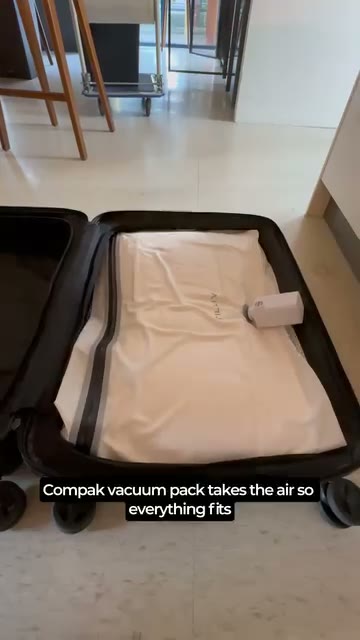
Pack the same clothes three ways, then add a realistic purchase and repack in a hotel-sized space. Measure the room left in each case.
Use the trip-home promise only if Compak leaves useful room and the case closes again.
What happens after 30 minutes, 24 hours, 72 hours, seven days, and several opening and closing cycles?
Use the seal claim only if several packs hold their shape.
Which clothes wrinkle, how long does repacking take, what does the pump add, and what should stay in an ordinary cube?
Name the clothes and trips that suit Compak, and those that do not.
03
Competitor pages make the packing result easy to see and the right size easy to choose. The strongest videos show the same clothes, different packing methods, and a clear final result.
Tilliv already makes the product, award, and before-and-after compression visible. The next example should make the 75% claim easier to judge inside a real suitcase.
The home page shows Compak inside a suitcase, a before-and-after slider, the claim of up to 75% more luggage space, the Red Dot award, press logos, the product range, social links, and email signup. Product pages add prices, pump choices, packing steps, care, and suitable clothes.
Use the same clothes and suitcase. Add dimensions to the current before-and-after comparison, then show the room left for one realistic purchase and what happens after several days and hotel repacking.
Ekster, Jaspacks, and Airback
The first screen explains the packing result before asking the traveller to study materials or specifications.
Build on Tilliv's before-and-after slider: show the same clothes inside a suitcase and the room left for the journey home.
Thule, July, and WANDRD
Sizes are connected to familiar clothes, trip lengths, and the luggage they fit.
Show which Compak fits each suitcase, what clothes it holds, and which pump is needed.
NOMATIC, Away, TUMI, Peak Design, and BEIS
These pages explain fit, care, wrinkles, returns, warranty, and what should not be compressed.
Put those answers beside the size and pump choice, not at the bottom of a long page.
Ekster names the vacuum-kit category, compares it with cheaper bags, and layers the mechanism and reassurance after the main result. Jaspacks explains its full opening, sizes, bag and pump weights, and space for shopping on the journey home. Airback makes compression easy to demonstrate and supports several regions, currencies, bundles, and related products.
Thule gives expanded and compressed dimensions with garment examples. July assigns familiar items to each size. WANDRD shows how several cube sizes fit together. Shoppers can choose without interpreting capacity figures alone.
Peak Design shows clean space shrinking as worn-clothing space grows. Taskin makes clean and worn separation the main use. BEIS combines compression cubes for soft clothes with ordinary cubes for items that should not be crushed.
NOMATIC summarises recurring positive and negative review themes. Away explains luggage fit, wrinkles, returns, care, and stores. TUMI names its product tests and offers registration, recovery, personalisation, and service.
Open with a case that will not close, a fixed set of clothes, or no room for the journey home. Materials and awards can come after the viewer understands why Compak matters.
Show the same clothes, the options being compared, and the final suitcase. Put room, time, wrinkles, and effort on screen.
Show creasing, extra steps, and any item that belongs in an ordinary cube. Let another option win when it works better.
These examples reached well above each channel's usual views. The useful lesson is the visible comparison, not the view count alone.
75.1 times the creator's usual views
Every method uses the same clothes. The final result is easy to see.
3.9 times the creator's usual views
The word overhyped makes viewers watch to see which products fail.
3.9 times the creator's usual views
The video shows a hotel repack, but does not measure room saved, time, or seal life.
Larger travel accounts post more video. They use carousels when a launch, comparison, or product detail needs several steps.
12 posts: 5 images, 3 carousels, 4 videos
Recent posts lean on awards, launches, and broad travel ideas. Use a carousel to follow one trip from packing at home to closing the case for the flight back.
36 posts: 1 image, 12 carousels, 23 videos
Airback and NOMATIC rely on video. Ekster uses carousels for launches and product stories. The product or result appears before the long caption.
48 posts: 2 images, 15 carousels, 31 videos
BEIS and Away support launches with several short posts. Pack Hacker names one benefit and one drawback, then links to the full review.
The sample contains the 12 posts returned for each of eight official accounts. Instagram can include pinned older posts, so it describes the current profile mix rather than a strict 12-post timeline.
Tilliv's public channel had three longer videos and a recent Shorts feed. Most accessible videos had small public view counts. Two older titles stood out in the flat feed.
About 2,300 views in the public flat feed
NEW! Compak with Divider gives the viewer a specific product change to inspect.
About 7,300 views in the public flat feed
Airlines don't love us and we get it creates curiosity before explaining the product.
The individual pages were unavailable when reopened, so these are clues from the public feed, not sales results.
The Reel reached far more people than the profile's recent posts. Public data does not show whether paid delivery helped.
The Reel opens while the bag is shrinking, then shows the valve, packing, and closure. It makes sense without sound.
The Reel received about 43 times the profile's recent median views in this sample.
Controlled lighting and close details make the product look durable and well made. The video does not test performance.
04
People search for a product, compare options, solve a packing problem, or check whether Tilliv is trustworthy. Give each search a page that answers it directly.
vacuum bags for travel with pump; reusable travel vacuum bags
Size, pump, luggage fit, delivery, returns, and price
Send the shopper to the closest product or collection page, with the answer visible before the long product detail.
vacuum bags vs packing cubes; clean and dirty packing cube
A fair explanation of space, access, wrinkles, effort, and trip use
Compare each option with the same clothes and suitcase. Let another option win where it is better.
carry-on for 7 days; business trip packing; winter packing; room for souvenirs
A useful answer before a product recommendation
Answer the trip question with a real packing test, then show where Compak helps and where it does not.
The exact words change what Google shows.
Search: Tilliv
Complete the official channels that can stay active: YouTube, Instagram, Facebook, TikTok, LinkedIn, and Pinterest. Turn each useful packing test into a video, carousel, post, or pin.
More active Tilliv profiles give Google more pages to show beside Trustpilot.
Search: Tilliv reviews
Start with four to six travel and packing creators. Supply the product, leave the verdict to them, and ask each reviewer to answer one question about space, seal life, hotel repacking, wrinkles, or ease of use.
More independent reviews give shoppers more than one answer when they compare Tilliv with other packing options.
Search: Tilliv complaints
Use Trustpilot's invitation system to send the same neutral request after customers have had time to use the product. Send one reminder and track delivery, clicks, and completed reviews.
A larger review base is less sensitive to a few ratings. The score rises only if later customers report a better experience.
A signed-out brand search showed Tilliv's site, Instagram, a press release, Trustpilot, official YouTube, and retailer pages. Competitor results often contained a wider mix of official channels, independent videos, retailers, and editorial coverage.
Why try it: Maintained Tilliv pages give Google more relevant choices for the direct brand search.
What it cannot guarantee: This query was not part of the controlled New York device sample. More accounts do not guarantee that Trustpilot moves down.
In the first controlled New York sample on 19 July 2026, Trustpilot appeared first on mobile and second on desktop. The YouTube review found one clear independent Tilliv review, while several competitors had broader independent coverage.
Why try it: More useful independent reviews would give shoppers other answers when they compare Tilliv with packing alternatives.
What it cannot guarantee: Supplying a product does not guarantee that a video will be published, rank, or be positive. The reviewer must keep control of the verdict.
Trustpilot appeared second on desktop and mobile in the controlled New York sample. It showed 2.7 out of 5 from 25 reviews, while the Compak Medium product page showed 4.94 out of 5 from 64 reviews.
Why try it: The small, sharply divided Trustpilot sample is worth broadening through a neutral and trackable request process.
What it cannot guarantee: More requests do not guarantee a higher score. The average rises only if the wider customer experience is better than the current Trustpilot sample suggests.
Tilliv often says pack smarter, save space, and stay organised. Competitor ads add a product name, an answer about reliability, an offer, or help choosing.
79 ads in the sampled US archive
Pack smarter, save luggage space, and keep clothes organised
Replace broad packing language with one specific trip or comparison question.
About 900 ads
Names the TravelPack Vacuum Bag and stresses long air hold
The product and one answer about reliability are clear at a glance.
About 60 ads
A clear offer supported by shipping, returns, and traveller count
The offer appears beside shipping, returns, and traveller count.
About 300 ads
A wider packing system with a bundle saving
The ad sells the bag as part of a complete travel setup.
About 2,000 ads
A seasonal bundle offer with links for locks, sets, and carry-ons
The promotion sits beside links to locks, sets, and carry-ons.
Tested roundups compare capacity, ease, durability, value, and longer use.
Comparison pages explain the trade between stronger compression and easier access.
Travel brands and publishers answer week-long, work, and winter packing questions before recommending products.
Tilliv did not appear prominently in the representative generic result sample. Search results change by place, device, and time, so this is a market sample rather than a universal rank report.
Tilliv already has several articles. Competitors answer more comparison and packing questions. Rather than match their volume, publish a smaller set of pages based on original packing tests.
| Site | Articles | Packing titles | Guide or comparison titles |
|---|---|---|---|
| Tilliv | 10 | 4 | 4 |
| Ekster | 426 | 19 | 123 |
| Airback | 22 | 14 | 10 |
| NOMATIC | 132 | 21 | 33 |
| Monos | 78 | 19 | 10 |
Counts come from public blog sitemaps. The title matches are a simple inventory, not a score for quality, traffic, links, or search rank.
Its public sitemap index contained 649 dated product-review sitemap files and 12 guide files. The current review feed includes packing cubes and travel bags. Pack Hacker runs a continuing review operation, not a small brand blog.
Its vacuum-bag roundup explains what was tested and compares capacity, ease, durability, and value. A seller page has to earn attention beside this kind of independent answer.
Forbes, Esquire, and HI USA answer business and winter packing questions before recommending products. They reach travellers before a product search begins.
05
Most Tilliv ads promise more space in similar ways. Keep the campaign simple. Show different travellers facing different problems at different points in a trip. Each ad should prove one result.
The archive shows compression, product choice, and hotel repacking. Four ads still opened with the same paragraph about flimsy vacuum bags.
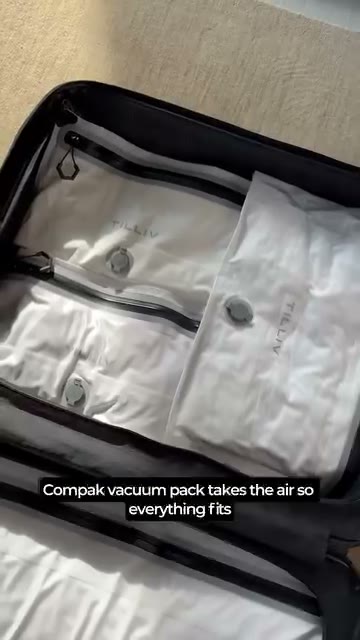
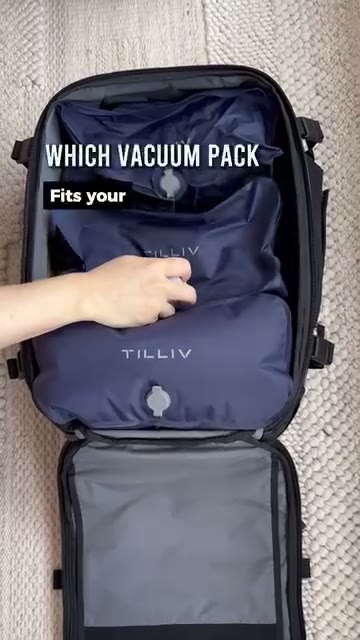
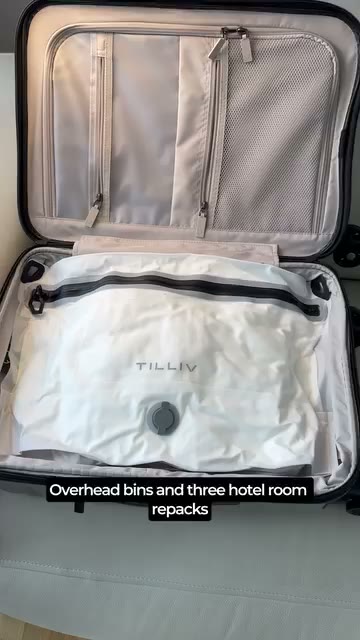
In the captured archive, 91% of records mentioned compression or more space. Only 19% mentioned the divider and 7% mentioned room for the journey home.
One video shows 20% off while the narration gives a 10% code. Similar ads led to different product, bundle, article, and home pages.
The comparison covered 207 active ads and 102 unique videos from eight advertisers. These are message and creative examples, not proof of sales performance.
The ads speak about luggage stress, extra bags, and overpacking. The viewer understands the easier moment before studying the mechanism.
Jaspacks opens on clothes that do not fit and then demonstrates the pack. Vollyc shows the starting pile, pump, compressed pack, and suitcase. Both are easier to follow than a feature list.
NOMATIC turns construction into short tests and product sequences. A visible test is more useful than saying the material is durable.
Their captions are shorter and the styling carries more of the message. They are useful attention benchmarks even though their products are not direct Compak substitutes.
The suitcase will not close, Compak removes the trapped air, and the suitcase closes. Lead with that result instead of materials and awards.
Suggested opening: The suitcase would not close. After Compak removed the trapped air, everything fit.
Each ad starts with a different packing problem and ends with a result the viewer can see. Film the test first. Use the result only if it is clear.
Five days of clothes. One carry-on. Space left for the trip home.
Pack T-shirts, trousers, underwear, and one light layer. Compare loose packing, a compression cube, and Compak in the same case. Add one purchase, then show whether the case still closes.
The suitcase is full. Then the snack aisle looks like this.
Follow a holiday traveller choosing boxed snacks and souvenirs, then returning to the hotel. Add those exact purchases and show whether the same carry-on closes for the flight home.
The packing cube keeps clothes tidy. Does it leave enough room?
Use the same clothes and carry-on twice. Pack once with a compression cube and once with Compak. Measure the room left and try to add the same souvenir to both.
Checkout in 20 minutes. Clean shirts here. Worn clothes there.
Show a consultant, banker, or executive packing again in a hotel room. Keep the laptop, toiletries, jacket, and wrinkle-prone shirts outside Compak. Time how long the case takes to close.
The clothes fit. The event materials do not.
Show a business owner packing clothes, equipment, and samples for the outbound trip. Add documents, gifts, or purchases for the return trip and show what still fits.
Three hotels. One suitcase. No complete repack.
Open, use, and close the same case at three hotel stops. Show whether clean and worn clothes remain separate and whether Compak is still compressed at the final checkout.
The clothes fit. The jacket does not.
Pack knitwear, thermals, trousers, and a jacket. Show the room before and after compression, weigh the case, and keep anything that creases badly outside Compak.
It looked flat on day one. What about day three?
Place Compak beside a common vacuum bag. Record both after 24 hours, 72 hours, and several hotel repacks. Use the footage only if repeated tests show that Compak stays compressed.
A country name is not the idea. Show what the traveller is doing there and why packing becomes difficult.
Use packaged snacks, small souvenirs, train travel, and a hotel repack to make the return-space problem visible.
Use shopping, several hotel stops, or bulky seasonal clothing when the trip makes that problem believable.
Use airport, hotel, conference, and early-checkout scenes. The job title matters less than the packing problem shown.
Send each ad to a page that answers the same packing question and shows the same test and offer.
Use one sales campaign for a broad US audience. Let the travel situations change in the ads instead of dividing a modest budget among many small groups.
Use a separate campaign for recent visitors, video viewers, and eligible Klaviyo subscribers who have not bought. Answer the doubt or continue the story that brought them in.
Put the holiday, work, and conference stories in separate ads, not separate small ad sets. Keep existing customers out of both groups. Add a customer campaign later only if repeat purchases or bundles justify it.
Set the campaign goal to Sales and give it one budget. Keep new customers and interested non-buyers separate so returning visitors do not inflate the new-customer results.
Set the country, exclusions, placements, and schedule. Start broad unless the offer or delivery area differs. Different travellers can still see different ads.
Change the travel situation, opening shot, test result, format, offer, or landing page here. Each ad must still make sense alone.
Klaviyo can send eligible non-buyers who recently clicked an email or visited a product page to a Meta Custom Audience. Exclude buyers, unsubscribed profiles, and suppressed profiles. Use the audience only with the required permission and expect Meta to match only part of the list.
An ad that was barely shown is still unknown, not a failure.
Use Shopify for completed orders. Use Meta and Google Analytics to see which ads and visits came before each order.
Check revenue against discounts, margin, returns, fulfilment, and the cost of making and running the ad.
A missing or duplicate sale can make an ad look better or worse than it is. Compare Meta with Shopify, then discuss whether the wider sales tracking needs more work.
Use Meta's test tools to confirm that the Pixel records product views, add to cart, checkout, and purchase once with the correct sale amount and currency.
Confirm that Conversions API sends the key store actions from Shopify. When the browser and Shopify report the same purchase, check that Meta counts it once.
Use one list of simple campaign names for Meta, Google, email, and organic social. Check that Google Analytics and Shopify keep the source, landing page, and order where consent allows.
Use Shopify for completed orders, Google Analytics for the visits it can observe, and each ad platform for delivery. Compare the gaps instead of adding every platform's claimed revenue together.
06
First, choose one question from Tilliv's past tests, customer feedback, returns, sales, and costs. Test it with the same clothes and suitcase. Use the result on the page and in ads only if the difference is clear. Check sales tracking and costs before paying for traffic.
Tilliv shares past product tests, common customer questions, return reasons, current claims, prices, and costs. Instavar compares these records with the public research in this brief. Together, choose one question: Does Compak leave room for purchases on the journey home? Does it stay compressed between hotel stays?
This decides exactly what the camera needs to show.
Pack the same clothes and carry-on without organisers, with a compression cube, and with Compak. Film the room left, the minutes taken, the wrinkles, whether Compak is still compressed after one day, and whether the case closes again after an extra item is added.
No visible difference means no ad claim.
If the comparison supports the claim, Instavar uses the result and footage to draft changes to the Compak page, a fair comparison page, a trip-home article, short videos, and Meta ads. Tilliv checks every product detail, delivery promise, and offer before publication.
A shopper should see the same result in the video and on the page.
Before paying for traffic, Instavar checks that Shopify and Meta record each purchase once with the right amount and currency. If the claim, tracking, stock, and budget are ready, a limited US test can begin. The orders are then checked against discounts, product cost, delivery, returns, the cost of making the ads, and ad spend.
Keep the ad, change it, or stop it.
Instavar identifies the official profiles worth keeping active and four to six independent travel reviewers to approach. Tilliv shows how Trustpilot requests are sent today. From that, agree which profiles to maintain, which reviewers to contact, and whether the review request should change. This work can start while the packing test is underway.
07
The pages, ads, videos, searches, reviews, and comments behind the recommendations.
This brief uses public websites, ads, posts, search results, reviews, and customer discussions. Together, they show where Compak may stand out and which pages and ads to test first.
Sources were checked from 10 to 17 July 2026 and can change. No product was physically inspected. Product tests and sales data are still needed before making firm claims or increasing ad spend.
The website review covered direct products, simpler compression alternatives, and premium travel brands competing for the same buyer attention. Each video is compared with the middle view count from that creator's recent posts, not with another creator.
The review collected 646 public videos. Twenty-one creators had at least six old-enough posts to estimate their usual views. Thirty-four packing-related videos performed above that level. Public views do not show sales, audience quality, paid delivery, or whether the format caused the reach. The exceptional Airback count should be treated with particular caution.
A bounded ScrapeCreators pass added 96 Instagram posts from Tilliv, Airback, Ekster, NOMATIC, BEIS, Away, Peak Design, and Pack Hacker. It used eight profile requests and eight credits. The endpoint can return pinned older posts, and public likes or comments do not show sales. Owned account exports are still needed for reach, saves, shares, profile visits, and orders.
The captured benchmark covered 207 active ads, 181 captions, and 102 unique downloaded videos from Airback, BEIS, Ekster, Flextail, Jaspacks, Monos, NOMATIC, and Vollyc. The public library does not show spend, orders, profit, or complete targeting.
The review used ten shopping, comparison, and trip-planning questions. It also checked verified US advertiser archives for Tilliv, direct product competitors, and larger travel brands.
Google Search presented a CAPTCHA during the clean-browser pass and was not bypassed. The result sample combines captured result pages, direct page checks, and public search indexes. Google's ad archive groups ads by advertiser and does not reveal which search triggered an ad.
The qualitative sample covered 135 comments from three TikTok videos, 69 comments from three YouTube videos, an eight-thread product follow-up, and 53 broader holiday-packing threads from 17 Reddit communities. It shows recurring concerns, the words travellers use, and questions to test. It does not show how common an opinion is among travellers or Tilliv customers.
These links are a readable source trail, not a statistical sample. Reddit users are self-selected, search results are ranked, and comment pages do not expose every reply in a consistent way.
US outbound data supports Japan, the UK, France, and Italy as holiday settings. Business booking data supports the UK, Canada, France, Germany, and Japan for work trips. These figures show where Americans travel, not where Compak will sell best. Use each country to make a packing situation concrete, not to create a separate ad set by default.