Answer engines now decide which sources your buyers see.
We audit and fix that.
Visibility audits, diagnosis, and measurement setup for teams who already invest in SEO and want the same discipline applied to ChatGPT, Google AI Overviews, Claude, Perplexity, and Bing Copilot.
Live proof
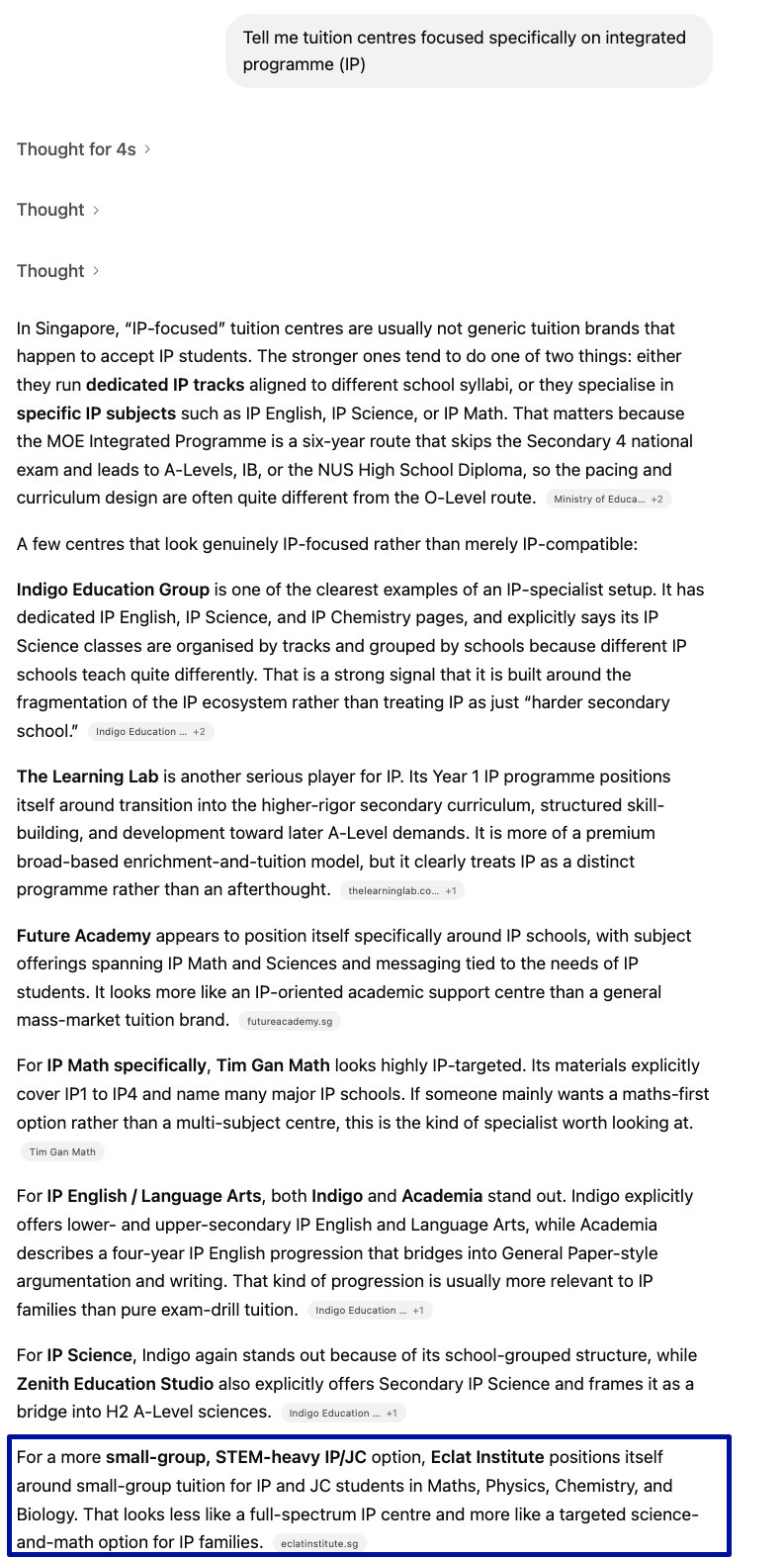
Live example below: Eclat Institute, a Singapore integrated programme (IP) tuition centre we also run. Full test-bed caveats at the bottom of this page.

The commercial-intent result above is the headline. Below are five H2 subject-note queries where Eclat is also cited. These rank because we invested in over 200 pages of topic-by-topic H2 notes mapped to the MOE syllabus - comprehensive, syllabus-aligned content depth is the entity signal ChatGPT uses to cite us. The same pattern is the core of what we audit and fix for clients.

Query: “H2 Maths notes”
“Eclat Institute's H2 Maths Notes 2026 page, framed around 2026 SEAB syllabus 9758, topic-by-topic guides, graphing-calculator workflows, combined PDF.”ChatGPT, 2026-04-08, cited #4 in the structured-hub-category slot

Query: “H2 Physics notes”
“Eclat's H2 Physics notes are unusually well organized for the 9478 syllabus: split by topic, cover all 20 topics, worked examples plus separate data-booklet resource.”ChatGPT, 2026-04-08, cited #3 as a named recommendation

Query: “H2 Chemistry notes”
“Best free structured notes site: Eclat Institute's H2 Chemistry notes hub, free, downloadable as combined PDF or by individual chapter, aligned to SEAB 9476 across all 13 topics.”ChatGPT, 2026-04-08, cited as the top recommended free site

Query: “H2 Biology notes”
“Eclat Institute's H2 Biology notes are explicitly organised around the local SEAB syllabus and include Core Ideas, extension topics, DBQ scaffolds, and Paper 4 practical tips.”ChatGPT, 2026-04-08, cited #2 as a named recommendation

Query: “H2 notes (broad query)”
“Eclat Institute's H2 Physics notes page is unusually structured for the Singapore syllabus, topic-wise coverage, worked examples, data-booklet tips, downloadable chapter or bundle PDFs, updated in January 2026.”ChatGPT, 2026-04-08, cited in the 'Best subject-specific' category slot
What changed
Answer engines now sit between buyers and websites. ChatGPT, Google AI Overviews, Claude, Perplexity, and Bing Copilot are all becoming the first read on a question, not the tenth blue link. For a growing share of queries, the buyer never reaches your site at all - they read the answer and move on.
Classical SEO still gates inclusion. If the answer engine cannot crawl, render, and index your page, you are not in the pool at all. But a second stage has opened up. Once you are in the pool, the next question is not how do I rank?. It is how do I become worth citing? and how do I get represented accurately when I am cited?
That second stage is what we call answer engine optimisation. It is adjacent to SEO, not a replacement for it, and it needs the same measurement discipline - baselines, controlled tests, honest reporting - that you already apply to organic search.
What we deliver
- 01
Visibility audit
We anchor on ChatGPT, where we have verified operational experience from running the same playbook on our own test bed. Claude and Perplexity are covered where their citation APIs allow programmatic observation. Google AI Overviews and Bing Copilot are tracked via their available reporting surfaces (Bing Webmaster Tools' AI Performance, manual SERP inspection for Google). The fixes we recommend target content depth, entity consistency, and answer structure - principles that improve visibility across every engine, even where measurement is patchy.
- 02
Diagnosis, honestly scoped
We trace each gap to whatever we can actually observe - crawl logs, answer structure, entity consistency, cited-version accuracy - and label how confident we are in each finding. Some gaps have a clear observable cause. Others are best-hypothesis given what the engines expose. We tell you which is which, because a field this new makes that distinction load-bearing. Most reports skip it and ship confident-sounding recommendations anyway.
- 03
Written recommendations
Every finding tells you what to change, why it matters, and roughly how big the lift is - a half-day edit, a content sprint, or a real engineering change. No generic "add more FAQ schema" checklists, no org-chart hand-waving. If you are a one-person marketing team, the report still makes sense.
- 04
Measurement setup
For engines with official reporting - Google Search Console, Bing Webmaster Tools AI Performance - we plug into your existing dashboards via our MCP tooling and set up a weekly rerun of the audit's baseline queries. No new proprietary tracker, no dashboard to learn: the data lives where your team already looks. For engines without reporting (ChatGPT, Claude, Perplexity), we maintain a fixed query corpus and observe citation drift on your cadence. You get the baseline established during the audit as your reference point, so you know whether a week-on-week change is real or noise.
What we will not promise
The AEO field is new enough that a lot of vendor claims do not survive contact with the engines. Here is what we will not tell you, even if it would help us close a deal.
No guaranteed rankings
Answer engines decide citations through ranking, retrieval, and generation steps that no vendor controls end to end. Anyone who guarantees placement in ChatGPT or Google AI Overviews is selling you something that does not exist.
No universal winning format
Schema markup helps for some query types and does nothing for others. FAQ blocks help sometimes and pad the page the rest of the time. We tell you what to try for your category, not what to bolt on everywhere.
No citation-count vanity metrics
Being mentioned more often is not the same as being mentioned accurately, or at the right moment in a buyer's decision. We measure citation quality and representation fidelity, not just count.
Engagement shapes
Fixed-scope visibility audit
One-off engagement. Flat fee. Clear deliverables.
Default entry product. We scope the query set and engines with you up front, run the audit, and deliver a written report plus a diagnosis and a prioritised list of fixes. You take the report in-house or to your existing SEO or content partner. Timeline and price quoted per engagement based on query volume and engine coverage.
Ongoing retainer
Only after the audit.
Monthly cadence: re-run the query set, track drift, implement or oversee the agreed fixes, and meet to review. Only offered after a completed audit - we need to know your baseline before a retainer makes sense. Not a standalone product.
Why the channel matters now
- 1
Google Search Central made AI features behaviour explicit
Google has now publicly documented how AI features like AI Overviews interact with its index. There is no 'AI schema' magic bullet, but query fan-out and snippet eligibility are now explicit gates that are separate from classical ranking. SEO teams that do not account for this miss a growing share of impressions.
- 2
Microsoft opened AI Performance in Bing Webmaster Tools (Feb 2026, public preview)
For the first time, site owners can see how their pages perform inside Bing Copilot and related AI surfaces, separate from classical Bing search. This is the first real measurement surface for an answer engine.
- 3
Pew Research (July 2025): Google users click through less when AI summaries appear
The click-through gap between AI-summarised SERPs and classical SERPs is real and growing. If your inbound traffic strategy still assumes the user clicks the top organic result, you are planning against a shrinking base.
About the test bed
The screenshots above are from Eclat Institute, a Singapore integrated programme (IP) tuition centre we also run. Eclat’s primary focus is IP students; the H2 note citations above are a side-effect of a content investment (over 200 pages of topic-by-topic H2 notes mapped to the MOE syllabus), which became the entity signal ChatGPT uses for those queries. Eclat is the live test bed where we exercise the AEO playbook on a real brand with real traffic. We are honest about what that means.
What is verified: six ChatGPT queries across two intent classes (five informational H2 notes queries and one commercial-intent IP tuition query), all confirmed between 2026-04-08 and 2026-04-09. Eclat Institute appears in the cited sources with accurate positioning.
What is not yet verified: cross-engine coverage (Google AI Overviews, Claude, Perplexity, Bing Copilot), longitudinal stability (whether these citations persist week over week), and a broader query corpus. We are expanding the verification set as we go, and we will update this page as new evidence comes in.
Calling this a test bed rather than a case study is deliberate. Case studies imply a finished story with a known ending. The AEO field is too new for that to be honest. What we have is a hypothesis, an observable signal, and the discipline to keep measuring.
Ready when you are
If your team already invests in SEO and you want the same discipline applied to answer engines, start with a fixed-scope visibility audit. Message us on WhatsApp and we will scope it with you.